
From the perspective of material origin, bathroom wall finishes can be categorized into five main groups: mineral-based materials (such as clay-fired ceramic tiles, gypsum boards, and glass), stone-based materials (natural marble), wood-based materials (including MDF and plywood), plastic-based materials (such as PVC vinyl wallpaper, self-adhesive wall tiles, SPC wall panels, and acrylic wall panel), and chemical coatings (primarily waterproof paint).
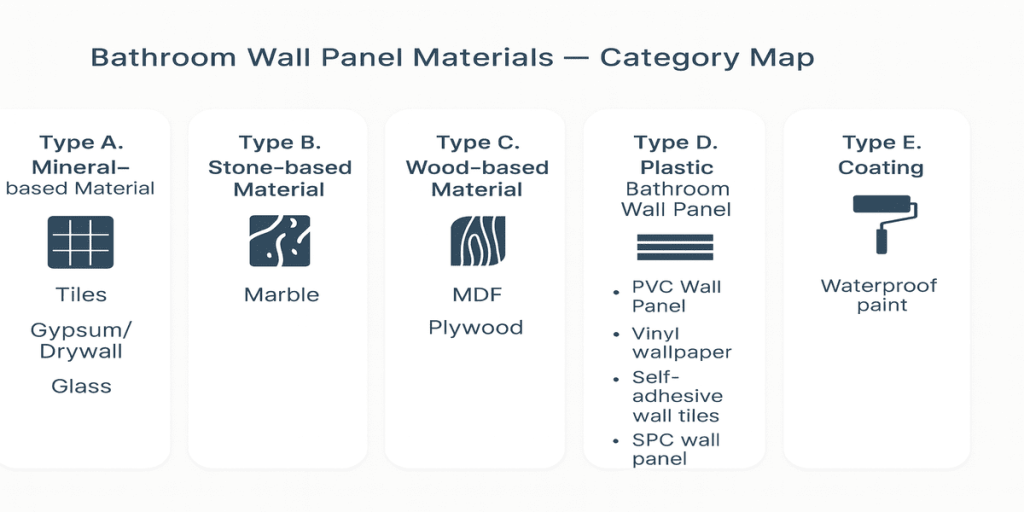
Type A. Mineral-based Material
I. Tiles
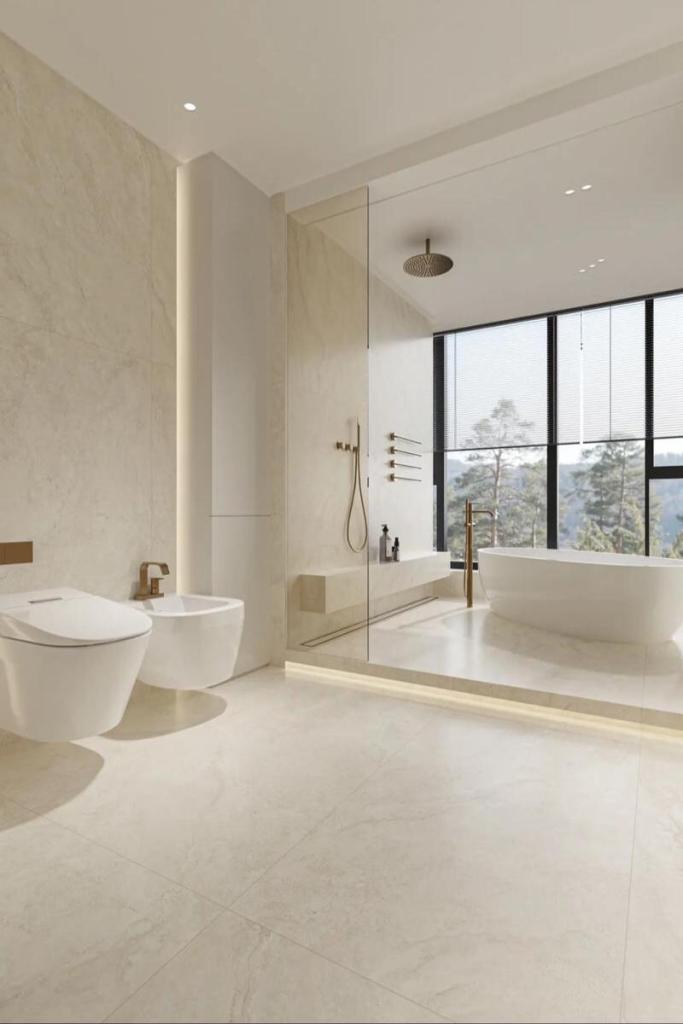
Tiles are made from raw materials such as clay, feldspar, and quartz, which are shaped and then fired at high temperatures to form hard and durable surfaces.
- Appearance
- Variety: Tile surfaces can be designed to imitate marble, wood grain, cement texture, fabric patterns, and many other effects.
- Texture: Options include matte, glossy, glazed, and polished finishes.
- Color choices: Almost unlimited and customizable to fit different interior styles.
- Overall effect: Flat and solid, suitable for modern, minimalist, traditional, Chinese, European, and various other styles.
- Specification & Properties
- Strength: High surface hardness (Mohs hardness 6–9), resistant to pressure and abrasion, and not easily scratched.
- Moisture resistance: Low water absorption (usually less than 0.5%), suitable for humid environments.
- Waterproofing: Impermeable itself, but relies on tile adhesive and grout; poor workmanship at joints may lead to leakage.
- Fire resistance: Non-combustible material, heat-resistant, commonly used in kitchens and around fireplaces.
- Environmental performance: Made mainly from natural clay, feldspar, and quartz fired at high temperatures, free of formaldehyde, and generally eco-friendly.
- Installation & Maintenance
- Installation: Requires tile adhesive, cement mortar, and other materials; the process is relatively complex, time-consuming, and demands skilled workmanship.
- Maintenance: The surface is easy to clean and highly stain-resistant; however, grout lines may trap dirt and require regular cleaning or re-grouting.
- Renovation difficulty: Once damaged or if replacement is desired, removal is relatively difficult.
- Cost
- Material cost: Varies greatly depending on quality, ranging from tens to several hundred RMB per square meter; imported brands or large-format tiles are more expensive.
- Labor cost: Relatively high due to the complex and time-consuming installation process.
- Overall cost: Higher upfront investment, but with a long service life (up to 20–30 years), offering good cost-effectiveness.
II. Gypsum/Drywall
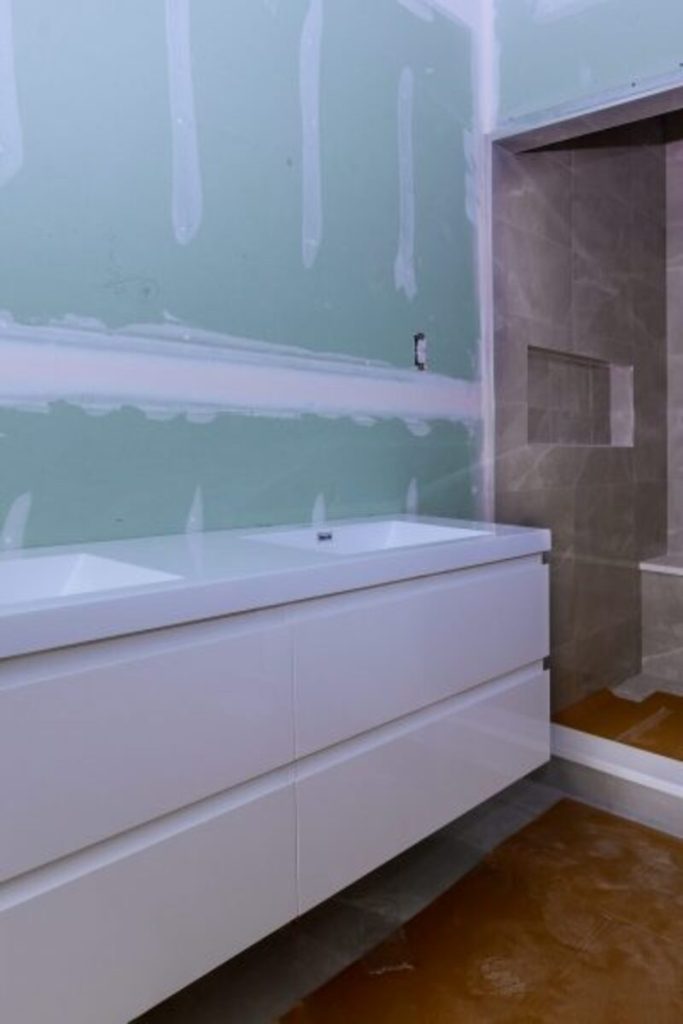
Gypsum board is made by pouring gypsum slurry between layers of paper (and sometimes reinforced materials like fiberglass), then drying and pressing it into rigid sheets.
- Appearance
- Color: Commonly available in green or blue paper-faced varieties (Green Board / Blue Board) to distinguish from standard gypsum board.
- Surface: Smooth and flat, usually requires additional finishes such as tiles, waterproof coatings, or PVC/SPC wall panels, rather than serving as a standalone decorative surface.
- Application: Primarily used as a substrate for bathroom walls or partitions.
- Specification & Properties
- Strength: Slightly stronger than regular gypsum board, capable of supporting general wall fixtures, but still weaker in impact resistance compared to tiles or SPC panels.
- Moisture resistance: Both the paper surface and gypsum core are treated with water-repellent additives, resulting in low water absorption and reduced risk of swelling or deformation.
- Waterproofing: Provides moisture resistance but not complete waterproofing; additional waterproof coatings or surface coverings are required.
- Fire resistance: Gypsum naturally contains crystalline water that releases steam when exposed to fire, giving it good fire-resistant performance.
- Environmental performance: Made mainly from natural gypsum and paperboard, generally eco-friendly, though attention should be paid to the environmental safety of additives and adhesives used.
- Installation & Maintenance
- Installation: Lightweight, easy to cut, and can be fixed with screws onto metal or wooden studs, making construction convenient.
- Post-treatment: Usually requires further waterproofing measures such as applying waterproof coatings or adding tiles/wall panels.
- Maintenance: Damaged sections can be cut and replaced locally, making repairs relatively simple; however, prolonged exposure to moisture may still cause deterioration into powder.
- Cost
- Material cost: Slightly higher than standard gypsum board, but still low-cost overall, usually around 30–80 RMB/m² (depending on region and brand).
- Labor cost: Simple installation process keeps labor costs low, cheaper compared to tile or artificial stone installation.
- Overall cost: Remains cost-effective, though additional expenses for waterproof coatings or surface finishes increase the total slightly.
III. Glass
Glass is made by melting silica sand together with soda ash and limestone at high temperatures, then cooling and shaping it into solid transparent sheets.
- Appearance
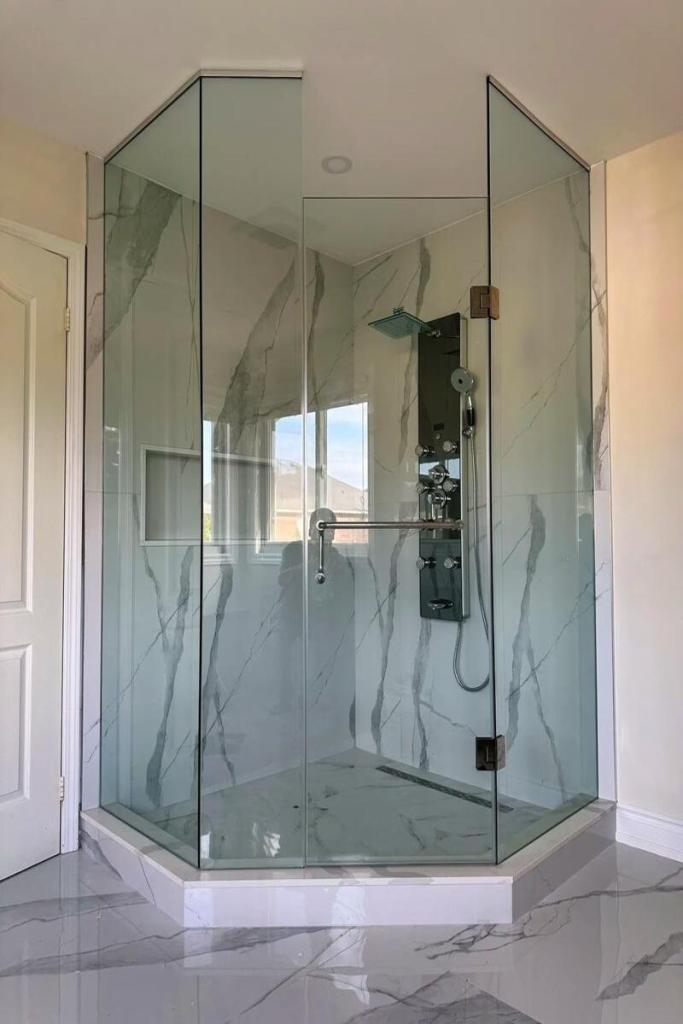
- Visual effect: Available in transparent, semi-transparent, frosted, coated, and colored options, allowing for modern, minimalist, or private bathroom designs.
- Decorative use: Commonly applied in bathroom partitions, shower enclosures, or as partial wall decorations. Frosted or patterned glass enhances privacy, while clear glass enhances the sense of space.
- Texture: Bright and transparent, offering a premium look and a lighter appearance compared to tiles or panels.
- Specification & Properties
- Strength: Typically made of tempered or laminated glass, which is 3–5 times stronger than ordinary glass and highly resistant to impact, making it less prone to shattering.
- Moisture resistance: Glass does not absorb water and is fully resistant to humidity, making it ideal for high-moisture environments.
- Waterproofing: Naturally waterproof, it does not deform or deteriorate when exposed to water.
- Fire resistance: Standard tempered glass may crack under high heat, but specialized fire-rated glass can maintain structural integrity for a certain period.
- Environmental performance: Made mainly from silica sand and minerals, it is free of formaldehyde, safe, recyclable, and environmentally friendly.
- Installation & Maintenance
- Installation: Requires professional installation, typically using stainless steel fittings, aluminum frames, or sealing strips.
- Maintenance: Easy to clean; stains and water scale can be removed with glass cleaner or vinegar solution. However, regular cleaning is necessary to prevent scale buildup.
- Note: If broken, glass must be replaced as a whole piece, which can be challenging.
- Cost
- Material cost: More expensive than gypsum board or standard ceramic tiles, generally ranging from 150–500 RMB/m², depending on thickness, processing, and whether laminated or coated.
- Labor cost: Higher, as installation requires skilled professionals.
- Overall cost: Mid-to-high level, suitable for bathroom designs emphasizing beauty, transparency, and modern aesthetics.
Type B. Stone-based Material
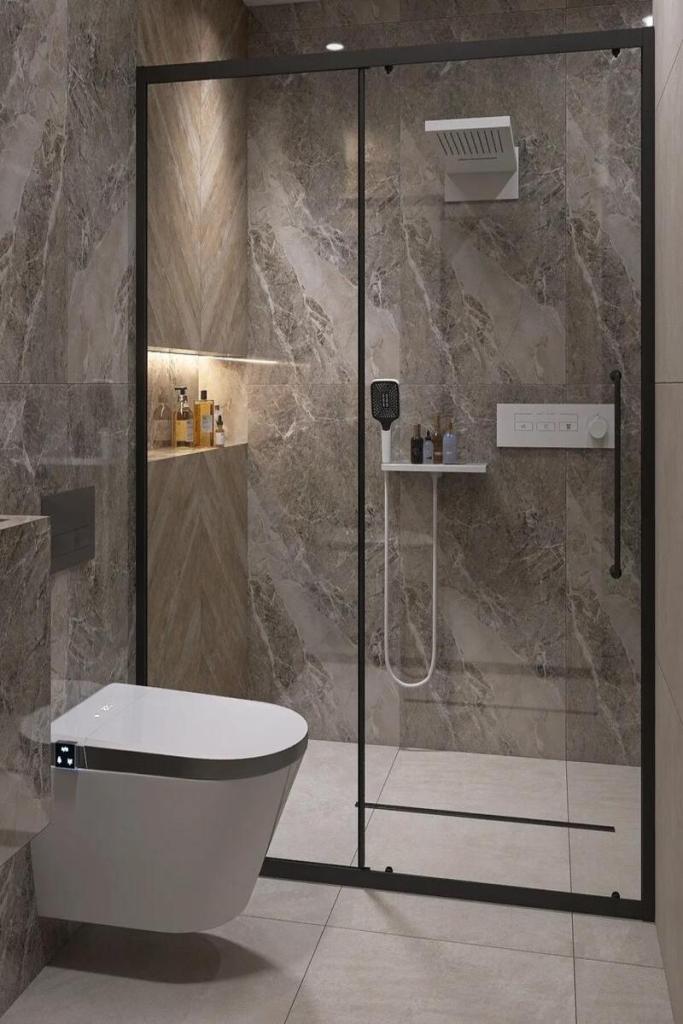
Marble is a natural stone formed from limestone that has undergone long-term heat and pressure in the earth, then quarried, cut, and polished into decorative slabs.
- Appearance
- Visual effect: A natural stone featuring unique patterns and colors (such as white, gray, beige, or black), with elegant and refined textures.
- Texture: Luxurious and upscale, often used in high-end bathrooms, providing a more prestigious decorative effect compared to ceramic tiles.
- Variety: Each slab has a one-of-a-kind pattern, adding artistic value to the space.
- Specification & Properties
- Strength: Marble has relatively high hardness and strong compressive strength, but weaker impact resistance, making it prone to chipping or cracking.
- Moisture resistance: Naturally dense and less absorbent, though some marbles contain fine pores and require surface sealing for better protection.
- Waterproofing: When polished and treated with protective sealants, marble provides good waterproof performance, suitable for bathroom environments.
- Fire resistance: As a natural inorganic stone, marble withstands high temperatures and does not burn, offering excellent fire resistance.
- Environmental performance: A natural material free of formaldehyde emissions, though its quarrying and processing may have environmental impacts.
- Installation & Maintenance
- Installation: Requires professional techniques, typically using wet installation (cement mortar) or dry-hanging (metal structures), with strict demands on substrate flatness.
- Maintenance:
- Clean daily with a damp cloth or neutral cleaner.
- Avoid acidic or alkaline cleaning agents (e.g., toilet cleaners, strong acids), as they may corrode the surface.
- Apply sealing/protective agents periodically to prevent water or stains from penetrating.
- Durable with a long service life, but susceptible to edge chipping if struck by hard objects.
- Cost
- Material cost: Considered a premium material, typically ranging from 400–1500 RMB/m²; rare varieties (such as Calacatta White or Fish Belly White) are even more expensive.
- Labor cost: Installation is complex, with labor fees generally higher than tiles or panels, around 150–300 RMB/m².
- Overall cost: High investment, ranking just below premium glass curtain walls, making marble a luxury choice for bathroom wall finishes.
Type C. Wood-based Material
Ⅰ. MDF
Water-resistant MDF is made by mixing wood fibers with moisture-resistant resins and additives, then compressing them under high temperature and pressure into dense boards. Bead board can be made from different materials (such as solid wood, plywood, or PVC), but the most common low-cost option is MDF Bead board, which is manufactured by compressing wood fibers with resin and then milling vertical grooves to create the Bead board pattern.

- Appearance
- Surface treatment: Bathroom-grade MDF is usually laminated (e.g., with PVC film or melamine paper), painted, or covered with waterproof veneers. The surface can imitate wood grain, stone patterns, or solid colors.
- Decorative effect: Good flatness and fine texture, offering decent decorative appeal, though it looks less natural than ceramic tiles or marble.
- Application: Commonly used for wall finishes or cabinetry in minimalist or budget-friendly bathroom designs.
- Specification & Properties
- Strength: MDF has a uniform internal structure and moderate strength, but its compressive and load-bearing capacity is lower than natural stone or ceramic tiles.
- Moisture resistance: Standard MDF swells and deforms when exposed to water; bathroom-grade MDF is produced with moisture-resistant additives and high-density pressing, but it is still unsuitable for prolonged direct water contact.
- Waterproofing: With sealed edges and laminated surfaces, it offers limited water resistance. However, its waterproof performance depends heavily on processing quality, and exposed edges are vulnerable to moisture.
- Fire resistance: As a wood fiber material, MDF is flammable; unless treated with fire retardants, its fire resistance is relatively poor.
- Environmental performance: E0/E1 grade MDF has low formaldehyde emissions and meets indoor environmental standards, though adhesives used in production still present a formaldehyde risk.
- Installation & Maintenance
- Installation:
- Easy to cut, drill, and shape with standard woodworking tools.
- Typically installed using adhesives, studs, or screws.
- Maintenance:
- Can be wiped with a damp cloth for daily cleaning, but prolonged water exposure should be avoided.
- Edges and joints must be well sealed to prevent moisture penetration and swelling.
- More suitable for dry/wet-separated bathroom zones; long-term humidity can shorten service life.
- Cost
- Material cost: Cheaper than ceramic tiles or stone, generally 80–200 RMB/m² for moisture-resistant MDF.
- Labor cost: Simple installation, with relatively low labor costs at about 60–120 RMB/m².
- Overall cost: Mid-to-low range, suitable for budget-conscious projects that still aim for some decorative appeal.
Ⅱ. Plywood
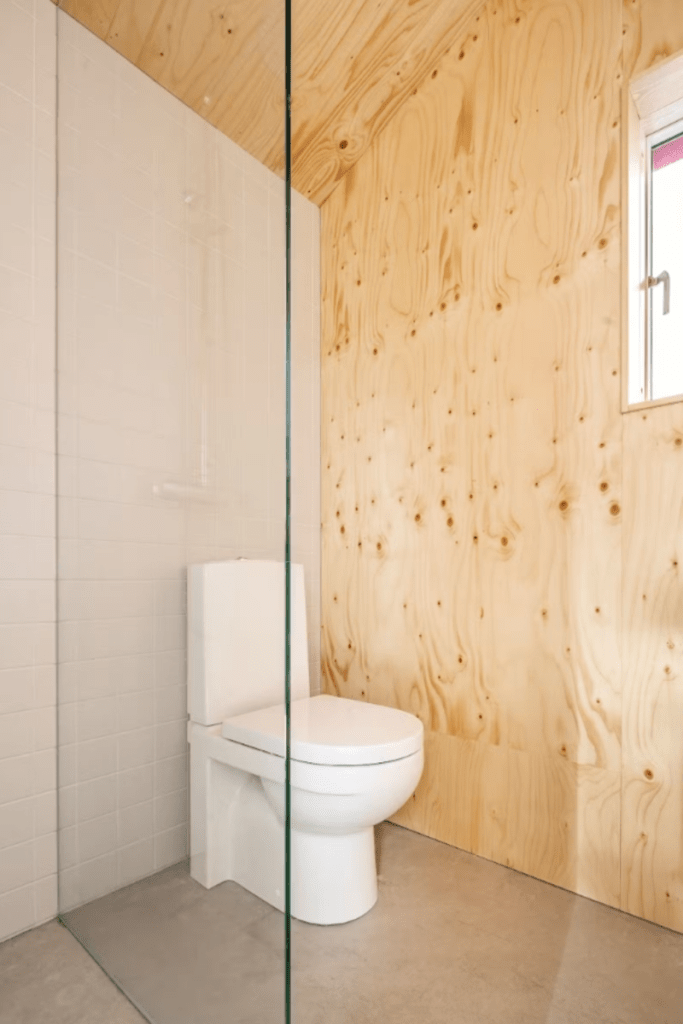
Plywood is made by gluing together multiple thin layers of wood veneer with the grain directions alternating, then pressing them under heat and pressure to form strong, stable boards.
- Appearance
- Surface treatment: Bathroom-grade plywood is usually finished with waterproof melamine paper, PVC film, or natural wood veneer, giving it appearances such as wood grain, stone patterns, or solid colors.
- Decorative effect: Compared with MDF, plywood has a more natural texture and a higher-end look; however, compared with ceramic tiles or marble, its style tends to appear more “warm and wood-like.”
- Application: Commonly used for bathroom cabinets, storage shelves, and wall finishes in dry zones.
- Specification & Properties
- Strength: Made by pressing multiple thin wood veneers with alternating grain directions, giving it better stability and strength than MDF, and making it less prone to warping or deformation.
- Moisture resistance: Moisture-resistant plywood maintains stability in humid environments, unlike regular boards that swell easily.
- Waterproofing: Marine-grade plywood, bonded with waterproof adhesives (such as phenolic resin glue), can withstand prolonged humidity and even some water immersion.
- Fire resistance: As a natural wood-based material, it is highly flammable and requires fire retardant additives or treatments to achieve adequate fire resistance.
- Environmental performance: The eco-friendliness depends on the adhesives used; E0/E1 grade plywood has low formaldehyde emissions, making it more suitable for bathrooms.
- Installation & Maintenance
- Installation:
- Similar to other woodworking processes—easy to saw, drill, and nail.
- Typically installed using studs or adhesive, suitable for DIY or professional installation.
- Maintenance:
- Daily cleaning with a damp cloth is sufficient; avoid prolonged water exposure.
- Edges and joints must be sealed properly (e.g., with edge strips or silicone) to prevent water infiltration and delamination.
- More durable in humid conditions than MDF, but still less resilient than mineral-based materials like tiles, marble, or glass.
- Cost
- Material cost: Slightly higher than MDF, generally 120–300 RMB/m² for moisture-resistant plywood; marine-grade plywood is more expensive.
- Labor cost: Simple installation process, labor costs around 80–150 RMB/m², similar to MDF.
- Overall cost: Mid-range; more economical than ceramic tiles or marble, but more durable than MDF.
Type D. Plastic bathroom wall panels
Ⅰ. PVC Wall Panel
(1)Vinyl wallpaper
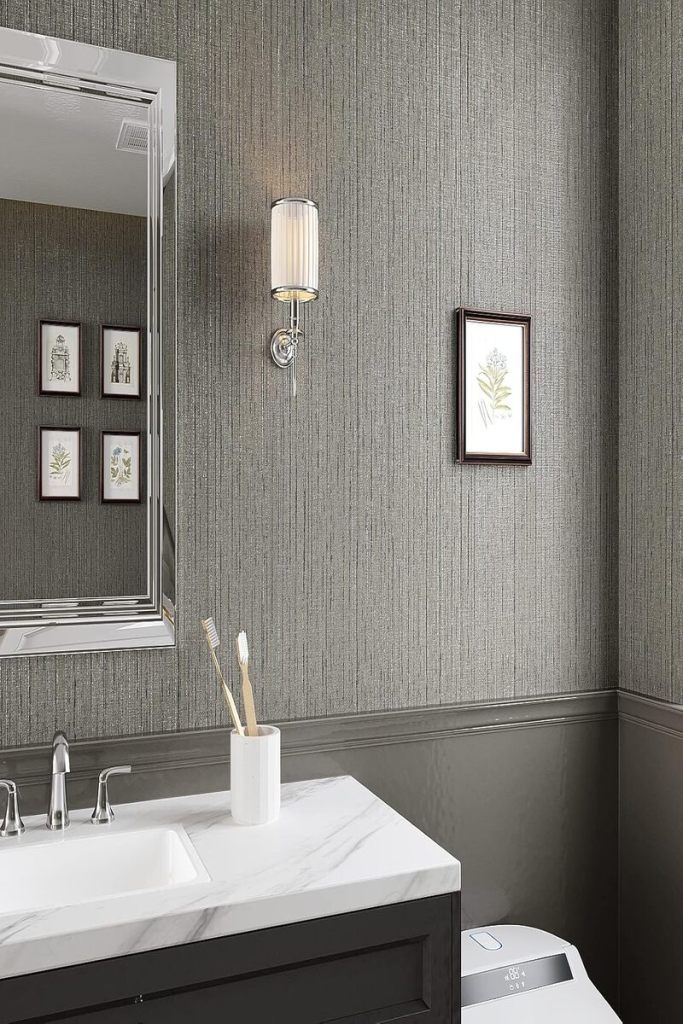
It is made by coating or laminating a decorative printed layer onto a paper or non-woven backing, then covering it with a layer of PVC film for durability and moisture resistance.
- Appearance
- Surface effect: Available in a wide range of patterns, including wood grain, stone texture, geometric designs, and solid colors, offering strong decorative appeal.
- Texture: The top layer is made of PVC film, which can be embossed or smooth, creating diverse visual effects.
- Overall style: Softer and warmer in appearance compared to tiles or marble, suitable for modern minimalist, Scandinavian, or country-style interiors.
- Specification & Properties
- Strength: The backing is typically non-woven fabric or paper, and durability is improved with the PVC coating, though overall mechanical strength is still lower than ceramic tiles, glass, or stone.
- Moisture resistance: The PVC surface helps block moisture, making it more suitable for bathrooms than traditional paper wallpaper.
- Waterproofing: Provides some waterproofing and can be used in humid environments, but not ideal for direct or prolonged water exposure; best suited for bathroom dry zones.
- Fire resistance: Regular PVC wallpaper is flammable; some versions contain fire retardants, but performance remains weaker than inorganic materials.
- Environmental performance: PVC-based composition carries some environmental concerns; higher-quality products can meet low-VOC standards, though overall eco-friendliness is lower than inorganic materials such as gypsum board or ceramic tiles.
- Installation & Maintenance
- Installation:
- Requires a flat, dry wall surface and is applied using special wallpaper adhesives.
- Relatively simple to install, suitable for DIY or professional application.
- Maintenance:
- Can be wiped with a damp cloth and has good stain resistance.
- Avoid prolonged soaking or strong scrubbing, which may cause bubbling or peeling.
- More durable than paper wallpaper, but lifespan in humid bathroom areas is limited (about 5–8 years).
- Cost
- Material cost: Affordable, generally 30–120 RMB/m² depending on thickness and design.
- Labor cost: Low, usually 20–60 RMB/m².
- Overall cost: Relatively low, much cheaper than tiles or marble, and even more economical than waterproof glass.
(2)Self-adhesive Wall Tiles
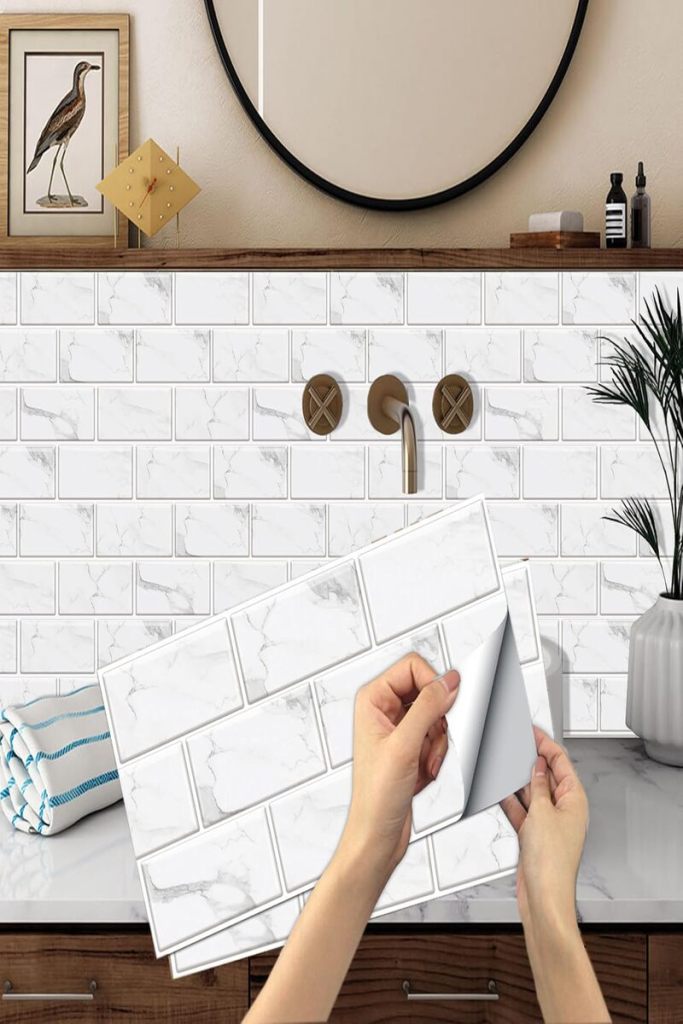
They are made by layering a decorative PVC, PET, or resin surface onto a thin backing sheet, with a pressure-sensitive adhesive applied on the back for easy peel-and-stick installation.
- Appearance
- Surface effect: Commonly designed to imitate ceramic tiles, stone, mosaic, or marble, available in a wide range of colors.
- Texture: The surface is usually made of PVC, PET, or resin; some products feature a 3D effect that closely resembles real tiles.
- Overall style: Suitable for modern minimalist interiors, quick renovations for small apartments, or rental makeovers, creating a clean and stylish look.
- Specification & Properties
- Strength: Made of PVC or composite sheets, with a total thickness of 1.5–4 mm; mechanical strength is limited and much lower than real ceramic tiles or stone.
- Moisture resistance: Both the adhesive backing and the PVC surface provide moisture resistance, making them usable in humid environments.
- Waterproofing: The surface itself is waterproof, but seams may leak over time due to poor installation or adhesive aging, so they are not recommended for prolonged direct water exposure.
- Fire resistance: Most are PVC-based; standard products are flammable, though some fire-retardant options exist. Overall fire resistance is weaker than stone or glass.
- Environmental performance: The eco-friendliness of PVC products depends on manufacturing quality and adhesive formulation; high-end products can achieve low VOC emissions with minimal odor.
- Installation & Maintenance
- Installation:
- Simply peel off the backing and stick onto a clean, flat wall surface.
- Requires almost no tools, adhesives, or mortar, making it ideal for DIY quick installation.
- Maintenance:
- Surfaces can be wiped with a damp cloth and are fairly stain-resistant.
- Avoid scratches from sharp objects; seams should be monitored for long-term waterproofing.
- Typically lasts 5–8 years in bathroom dry zones; less suitable for shower areas unless replaced regularly.
- Cost
- Material cost: Affordable, usually 50–150 RMB/m², much cheaper than real ceramic tiles.
- Labor cost: Nearly zero since they can be installed DIY; professional installation, if used, is inexpensive (10–30 RMB/m²).
- Overall cost: Very low compared to tiles or marble, making it a good choice for budget-conscious or quick renovation projects.
(3)Spc Wall Panel
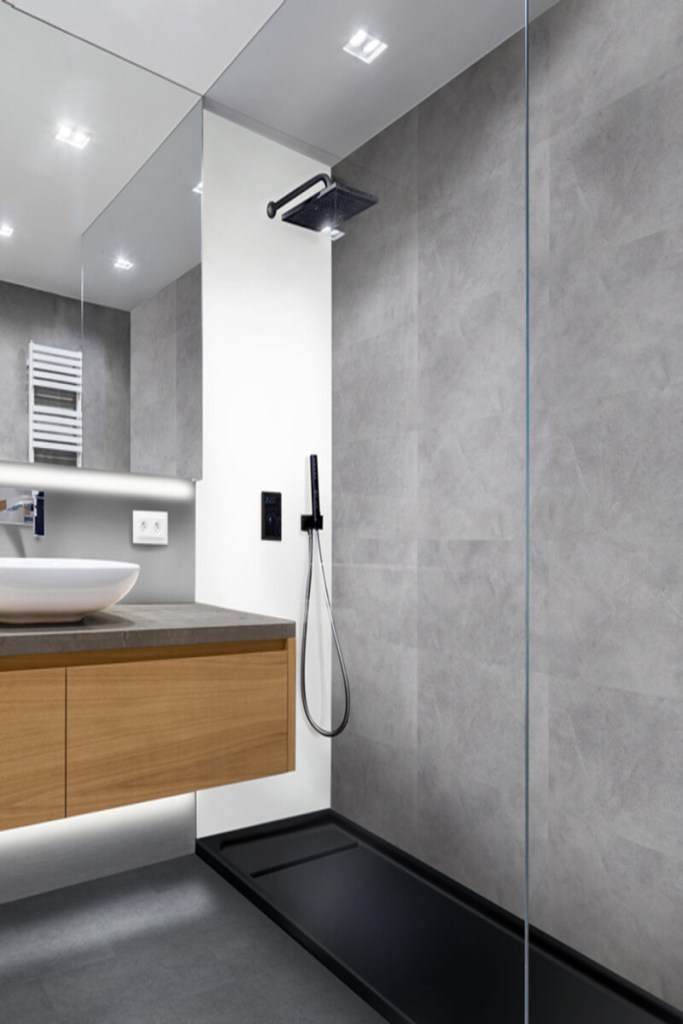
SPC wall panels are made by combining PVC resin with calcium carbonate (stone powder), then extruding the mixture under high temperature and pressure to form dense, rigid boards with a decorative surface layer and protective UV coating.
- Appearance
- Surface effect: Can be made with wood grain, stone grain, brick patterns, or solid colors. The surface is finished with a hot-pressed decorative layer and a UV coating, allowing for matte, glossy, or even 3D effects.
- Overall style: Highly decorative, capable of replacing ceramic tiles or marble, with a natural and realistic visual effect.
- Specification & Properties
- Strength: Produced by extruding a mixture of PVC and calcium carbonate (CaCO₃) under high temperature and pressure, giving it high density, hardness, and better impact resistance than standard PVC boards.
- Moisture resistance: The stone-plastic core does not absorb water and remains dimensionally stable in humid environments, making it ideal for bathrooms.
- Waterproofing: Uses a click-lock system with tightly sealed joints, providing excellent waterproofing suitable for direct use in wet areas.
- Fire resistance: Typically achieves Bfl-s1 under EN 13501-1 standards, offering good flame-retardant performance and preventing fire spread.
- Environmental performance: Free from formaldehyde, compliant with environmental standards, and recyclable.
- Installation & Maintenance
- Installation:
- Can be measured, cut, and drilled with standard woodworking tools.
- Walls require little surface leveling; panels can be installed using silicone with double-sided tape or via a click-lock system.
- Installation is 2–3 times faster than tiles, suitable for both DIY and professional construction.
- Maintenance:
- The UV surface layer is stain-resistant and scratch-resistant; daily cleaning can be done with a soft cloth, warm water, and neutral cleaners.
- Grease can be removed with plastic-safe cleaning agents, making maintenance simple.
- Cost
- Material cost: Around 150–300 RMB/m², lower than natural stone or tempered glass but higher than self-adhesive wall tiles or standard wallpaper.
- Labor cost: Due to easy installation, labor costs are lower than tile work, usually 60–120 RMB/m².
- Overall cost: Cheaper than ceramic tiles or marble, with high cost-effectiveness, making it suitable for large-scale renovations.
Ⅱ. Acrylic
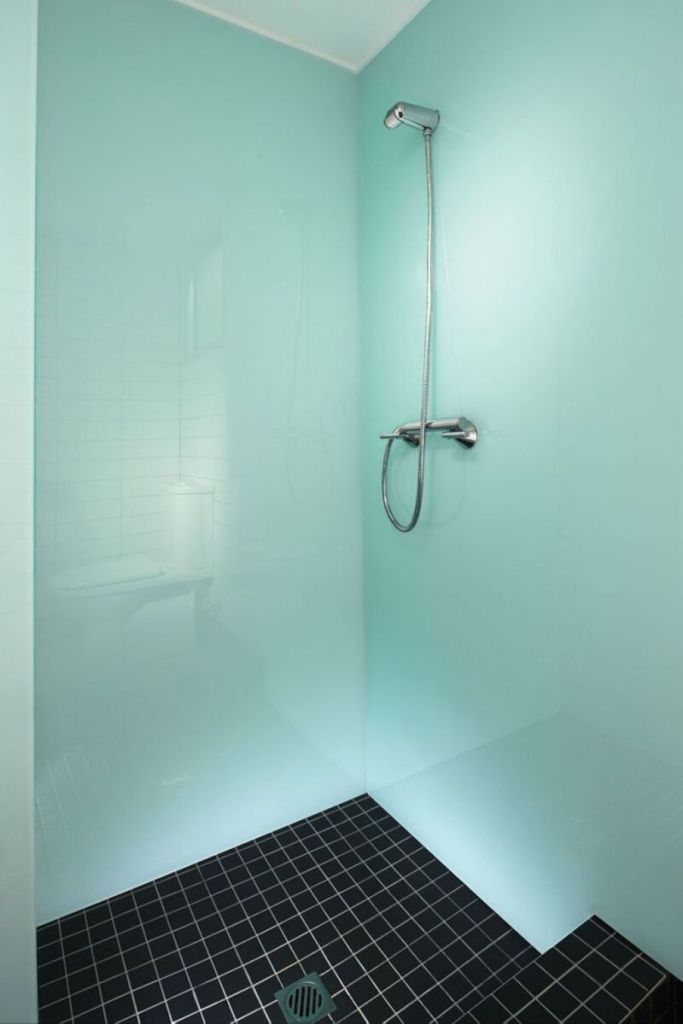
Acrylic wall panels are made by heating and compressing PMMA (polymethyl methacrylate) powder through casting or extrusion, then finishing with polishing or protective coatings to create large, glossy sheets.
- Appearance
- Surface effect: High gloss, smooth, and flat surface with a mirror-like finish.
- Color options: Typically solid colors, creating a modern and minimalist visual effect, ideal for sleek or high-brightness bathroom designs.
- Overall impression: Large panels (commonly 990×2440 mm or 1500×2440 mm) with minimal seams, giving a strong sense of continuity.
- Specification & Properties
- Strength: Made of PMMA (polymethyl methacrylate), offering good hardness and impact resistance superior to glass, though slightly weaker than stone or SPC.
- Moisture resistance: Non-absorbent, maintaining stability in wet areas without swelling or deformation.
- Waterproofing: Dense material with excellent waterproof performance, though seams sealed with adhesive are less effective than SPC click-lock systems.
- Fire resistance: Typically rated B2 under DIN 4102 standards, with lower flame resistance compared to SPC or fireproof boards; caution is required in open-flame environments.
- Environmental performance: The raw material is recyclable, but production involves chemical additives, making it slightly less eco-friendly than SPC.
- Installation & Maintenance
- Installation:
- Can be cut and drilled with standard woodworking tools.
- Generally installed using silicone plus double-sided adhesive.
- Due to its heavier weight (around 30 kg/m²), handling and installation usually require two people.
- Maintenance:
- Smooth surfaces are easy to clean with a soft cloth, warm water, and neutral detergent.
- Avoid hard tools or strong acids/alkalis to prevent scratches or corrosion.
- Cost
- Material cost: Relatively high, around 400–600 RMB/m², more expensive than SPC, wallpaper, or self-adhesive tiles, comparable to mid-range stone.
- Labor cost: Higher than SPC due to its size and weight, generally 100–150 RMB/m².
- Overall cost: More expensive than SPC, MDF, or wallpaper, but cheaper than natural marble and some premium ceramic tiles.
Type E. Coating
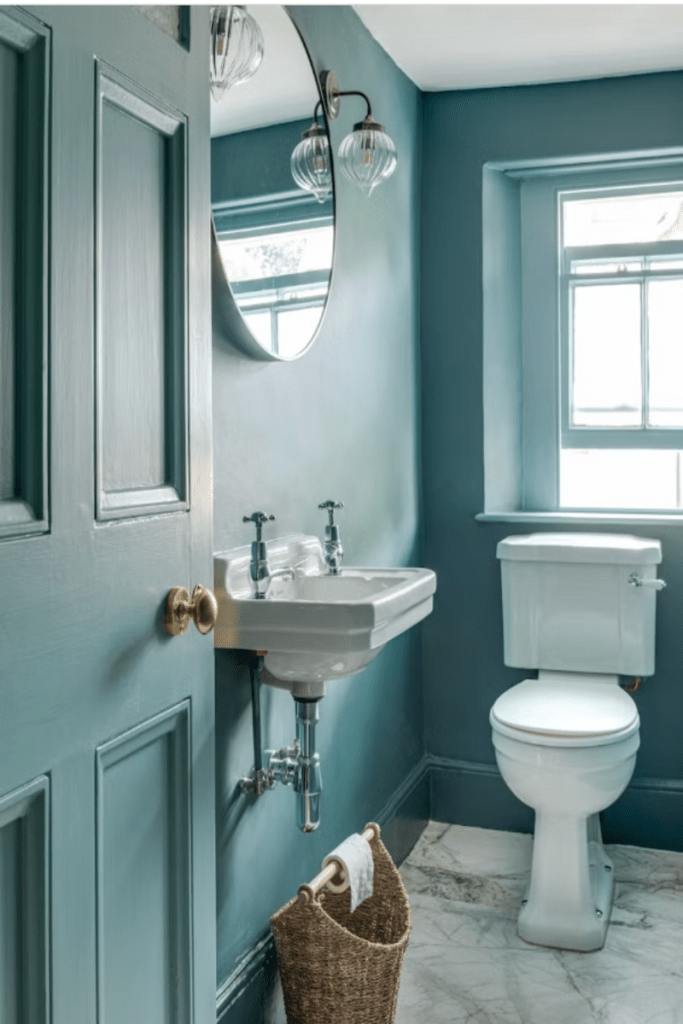
Waterproof paint is made by blending synthetic resins, pigments, fillers, and waterproofing additives, then processed into a liquid coating that forms a seamless, water-resistant film when applied and cured on surfaces.
1. Appearance
- Surface effect: Usually matte or semi-gloss with a fine texture, creating a simple overall look.
- Color options: Available in a wide range of colors that can be customized; however, it has weaker decorative appeal compared to tiles or acrylic panels.
- Overall impression: Seamless application provides an integrated wall finish.
2. Specification & Properties
- Strength: Limited strength on its own and typically applied over a solid base (such as cement mortar or gypsum board); can be easily scratched by sharp objects.
- Moisture resistance: Offers good moisture resistance, suitable for humid environments.
- Waterproofing: Dense coating effectively blocks water penetration, but requires uniform application without skips or pinholes.
- Fire resistance: Most waterproof paints are water-based and classified as Class B flame-retardant, sufficient for bathroom use.
- Environmental performance: Water-based acrylic or polyurethane formulations are environmentally friendly, low-VOC, and compliant with green building standards.
3. Installation & Maintenance
- Installation:
- Easy to apply by rolling, spraying, or brushing.
- Substrates must be smooth and clean for proper adhesion.
- Typically applied in 2–3 coats, allowing full drying time between each.
- Maintenance:
- Easy to clean with a damp cloth or warm water.
- Damaged or cracked areas require localized repair or re-coating.
4. Cost
- Material cost: Relatively low, usually 30–80 RMB/m² (based on coating area).
- Labor cost: Also low, generally 40–80 RMB/m², though multiple applications and drying times are needed.
- Overall cost: Much lower than tiles, acrylic, marble, or SPC panels, making it an economical choice for bathroom wall waterproofing.
Conclusion
· Best overall balance (4–5 across the board): SPC Wall Panel
· Most premium/high-end: Marble, Ceramic Tile, Bathroom Glass, Acrylic Wall Panel
· Most economical: Waterproof Paint, Vinyl Wallpaper, Self-Adhesive Wall Tile
· Weakest for bathrooms: MDF, Plywood (unless specially treated)
| Item | Material | Appearance | Specification | Installation & Maintenance | Cost (Material + Labor) |
|---|---|---|---|---|---|
| Mineral | Ceramic Tile | 5 | 5 | 3 | 2 |
| Gypsum Board | 3 | 3 | 4 | 4 | |
| Bathroom Glass | 5 | 5 | 3 | 2 | |
| Stone | Marble | 5 | 5 | 3 | 1 |
| Wood | MDF | 3 | 2 | 2 | 5 |
| Plywood | 4 | 3 | 3 | 3 | |
| Plastic | Vinyl Wallpaper | 4 | 3 | 4 | 4 |
| Self-Adhesive Wall Tile | 4 | 2 | 5 | 4 | |
| SPC Wall Panel | 4 | 5 | 5 | 4 | |
| Acrylic Wall Panel | 5 | 4 | 3 | 2 | |
| Coating | Waterproof Paint | 3 | 3 | 4 | 5 |
FAQ
1. What is the most durable material for bathroom wall panels?
The most durable bathroom wall panel materials are SPC wall panels, marble, and ceramic tiles. Among them, SPC wall panels stand out for their excellent waterproofing, fire resistance, and easy installation, making them ideal for both wet and dry bathroom areas. Marble and ceramic tiles offer premium aesthetics and long service life, but they require higher installation costs and maintenance.
2. Are SPC wall panels better than acrylic bathroom wall panels?
SPC wall panels: High strength, excellent moisture/water resistance, click-lock installation, cost-effective, suitable for large bathroom projects.
Acrylic wall panels: High gloss, seamless modern look, easy to clean, but more expensive and weaker in fire resistance.
3. What is the most cost-effective bathroom wall panel option?
For homeowners on a budget, waterproof paint, vinyl wallpaper, and self-adhesive wall tiles are the most affordable choices. They are easy to install (even DIY), require low upfront investment, and provide decent moisture protection. However, for long-term bathroom renovations, SPC wall panels offer the best balance of cost, durability, and style.


 SPC Wall Panel
Leave a reply to Embossed SPC Wall Panel: Surface Treatment and Embossing Process – SPC Wall Panel Cancel reply